
Data Engineering & Analytics
You need expertise, not just execution
Businesses at $100k-500k/month face critical data infrastructure decisions but lack internal expertise to make them confidently. Should you use Snowflake or Databricks? Build custom pipelines or use Fivetran? Implement dbt or a different transformation approach? Each choice has major cost, maintainability, and capability implications. Vendors pitch their solutions. Consultants push whatever they specialize in. You need someone who knows the entire ecosystem, can evaluate options objectively based on your specific needs, and implement solutions you can actually maintain long-term.
Where data infrastructure decisions go wrong
- Vendors sell what they have, not what you need: Snowflake reps pitch Snowflake regardless of whether Databricks might fit better. Fivetran sells their connector catalog even if your use case needs custom extraction logic. Every vendor conversation ends with "our solution is perfect for you" - but someone needs to evaluate objectively based on your actual requirements, scale, team capabilities, and budget.
- Consultants build what they know, not what's maintainable: Many data engineers love writing code and building custom solutions. They'll architect sophisticated pipelines using their preferred frameworks, then hand off complex systems to businesses without engineering teams to maintain them. Six months later, something breaks and nobody knows how to fix it. The business is stuck maintaining unmaintainable infrastructure.
- Build vs buy decisions lack informed perspective: Should you pay Fivetran $3k/month for connectors or build extraction logic yourself? Use Segment's reverse ETL or implement Hightouch? Packaged CDP or composable stack? These decisions have long-term lock-in implications and significant cost differences at scale, but most businesses lack experience across enough tools to evaluate trade-offs confidently.
- Vendor contracts get signed without negotiation leverage: First conversation with Snowflake or Databricks sales leads directly to standard pricing and contracts. Businesses don't realize significant discounts are available, commit structures can be negotiated, or which levers create favorable terms. Lack of procurement expertise costs tens of thousands in overpaying for standard deals.
Strategic guidance + practical implementation
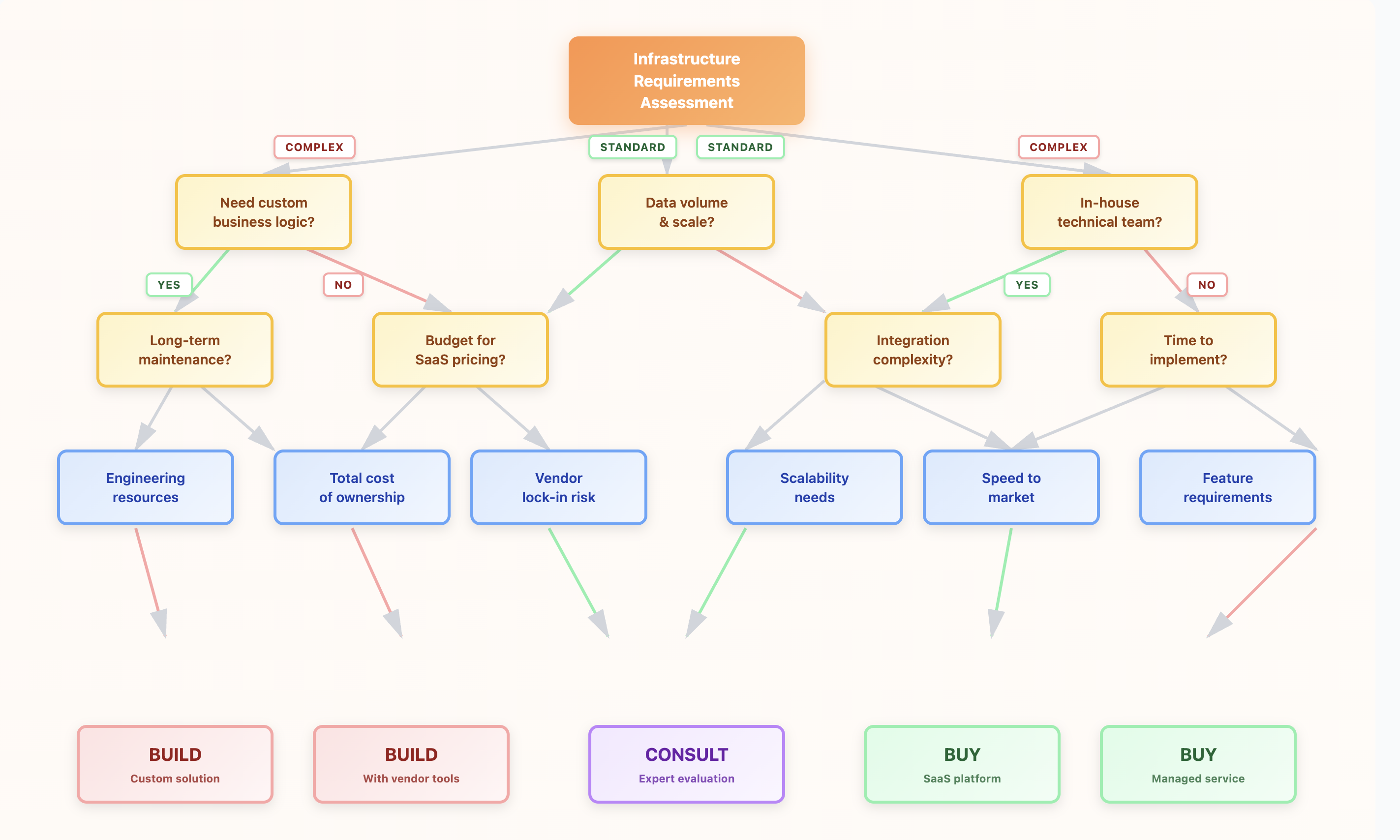
Data engineering consulting combines strategic advisory with hands-on implementation. Evaluate your requirements, team capabilities, and growth trajectory to recommend build-vs-buy decisions across the stack. Navigate vendor negotiations to secure favorable pricing and terms. Then implement chosen solutions with maintainability as priority - using managed services and established patterns that businesses without dedicated engineering teams can actually operate long-term.
- Technology stack evaluation and recommendations assessing Snowflake vs Databricks vs BigQuery based on your specific workloads, team SQL vs Python skills, integrations needed, and projected scale - objective comparison of total cost of ownership, capabilities, and lock-in implications for your situation
- Build vs buy analysis across data infrastructure evaluating when Fivetran's $3k/month connector makes sense vs custom extraction, when reverse ETL tools justify cost vs building sync logic, when to use packaged solutions vs composable architectures - recommendations based on your team's ability to maintain solutions, not consultant preferences
- Vendor negotiation and contract optimization leveraging procurement expertise and market knowledge to secure discounts, negotiate favorable commit structures, avoid unnecessary add-ons, and structure contracts that align with your growth trajectory - saving $20-50k+ annually on standard infrastructure spend through informed negotiation
- Architecture design for maintainability prioritizing managed services, established frameworks (dbt, Airflow), and clear documentation over custom code and bespoke solutions - infrastructure that businesses without full-time data engineers can operate successfully because complexity is managed by vendors, not internal code
- Implementation with knowledge transfer building infrastructure hands-on while teaching internal teams how it works, what to monitor, how to troubleshoot common issues, and when to call for help - not black-box delivery but collaborative implementation that builds internal capability
- Vendor relationship management serving as technical liaison with infrastructure providers - escalating issues, requesting features, interpreting roadmaps, evaluating new capabilities - ongoing relationship that ensures you get value from vendor partnerships instead of navigating support mazes alone
- Future-proofing and migration planning designing infrastructure with flexibility to switch vendors, adopt new tools, or scale architectures as business grows - avoiding lock-in and maintaining optionality as data needs evolve and better solutions emerge in fast-moving ecosystem
What strategic data engineering enables
- Make infrastructure decisions with confidence: Choose between Snowflake and Databricks based on your actual workloads and team, not sales pitches. Decide build-vs-buy with clear understanding of maintenance burden and total cost. Commit to vendors knowing you negotiated favorable terms and have flexibility to change later. Confidence comes from expertise evaluating entire ecosystem, not single-vendor perspective.
- Avoid expensive mistakes and technical debt: Skip the "let's build custom pipelines because we can" phase that creates unmaintainable spaghetti code. Avoid signing Snowflake contracts at list price when 30-40% discounts are standard. Don't lock into Segment when Hightouch would cost 1/3 and meet your needs. Experienced guidance prevents costly detours and rework.
- Actually maintain infrastructure after implementation: When systems are built with managed services and established patterns, businesses without data engineering teams can operate them successfully. Troubleshooting is Googling error messages and checking documentation, not debugging custom code. Maintenance is updating configurations, not rewriting pipelines. Infrastructure that works long-term, not just at launch.
- Build relationships with vendors, not just contracts: Having experienced technical advisor in vendor conversations changes dynamics - sales reps know they can't BS on capabilities, support teams prioritize issues appropriately, account managers actually deliver on promises. Strong vendor relationships mean infrastructure works smoothly because partners are invested in your success.